Based on what I know about the character of Lady Macbeth, these are the shows and movies I think she would watch and recommend:
1. Bonnie and Clyde- Based on the true story of Clyde Barrow and Bonnie Parker, Barrow, a charismatic convicted armed robber, sweeps Parker- a young and impressionable, petite, small-town waitress, who is already married – off her feet. In the early 1930s, the two embark on one of the most infamous crime sprees in American history. At first, they are having the time of their lives going on numerous bank-robbing sprees, sparked by Bonnie's dream of becoming a Hollywood movie star. However, soon, Bonnie pushes Clyde to commit more heinous crimes to generate headlines in the newspapers, and their life of crime soon leads to their death
For a split second in the Shakespearean tragedy, Macbeth and Lady Macbeth were just like these characters. Young, in love, and conniving criminals, although by way of murder instead of robbery. Lady Macbeth would most likely have watched this movie because it basically describes her entire relationship with Macbeth, with a few minor adjustments. In the movie, Clyde influences Bonnie to go on crime sprees with him whereas Lady Macbeth is the influencer of Macbeth because obviously, she wears the pants in the relationship. The only major difference between Bonnie and Lady Macbeth is that Bonnie continued to spin out of control with her impulse to rob while Lady Macbeth decided to find a conscience and stop with her criminal activity. Either way, both of the leading ladies ended up dying, although Lady Macbeth, by her own hand.
2. Beyond the lights- The story focuses on Noni, a British female R&B singer of mixed raise who is on the rise to becoming a pop star. She's got everything going for her: looks, fashion sense, a beautiful voice, and a famous rapper boyfriend. However, she feels she is only being taken advantage of until she meets Kaz, a police officer who claims to see through her act after she catches her from falling off a balcony where she tried to commit suicide. Although Kaz initially avoids Noni because he was forced to lie at a subsequent press conference, they eventually become close. He builds her courage and various ways and eventually the two fall in love.
I would bet that Lady Macbeth wishes her life could be like Noni's. On the outside, she is this strong, independent woman who does what she wants, but on the inside, she's probably just as vulnerable as any other woman and just wants to be genuinely loved. The fact that Noni was able to break out of her fake act to be the woman (and musician) she really wanted to be, even after she attempted to kill herself, most likely really motivated Lady Macbeth to try to turn her life around, even after her husband has become a blood-thirsty murderer. However, apparently it didn't motivate her enough to stop her from committing suicide, and therefore, she probably watched this a long time before she decided to do this.
3. Cake- Claire Bennett is in pain. Her physical pain is evident in the scars that line her body and the way she carries herself, wincing with each tentative step. She’s no good at hiding her emotional pain either. Blunt to the point of searing insult, Claire’s anger seethes out of her with nearly every interaction. She has driven away her husband, her friends — even her chronic-pain support group has kicked her out. The only one left in Claire’s otherwise solitary existence is her housekeeper-cum-caretaker, Silvana, who barely tolerates her boss’ need for liquor and prescription pills. But the suicide of Nina, one of Claire’s fellow chronic-pain group members, prompts another fixation. In pursuing questions about the death of a woman she barely knew, Claire explores the boundaries between life and death, abandonment and heartbreak, danger and salvation. As she inserts herself into the lives of Nina’s husband and the son Nina left behind, Claire just might find salvation.
Again, this was probably another one of the movies Lady M used to try to find some motivation. She probably thought that if this woman could overcome her extreme emotional and physical pain then so could she.
4. How to Get Away with Murder- A sexy, suspense-driven legal thriller about a group of ambitious law students and their brilliant, mysterious criminal defense professor. They become entangled in a murder plot that will shake the entire university and change the course of their lives.
Lady Macbeth is, in some way, similar to all of the main characters in this series. In the show, Annalise Keating is a manipulating law school professor who uses her top 5 law students and her 2 assistants to further her own, not-so-noble, agendas. However, she is not the only of them with dark secrets. All of the students and assistants possess mysteries about themselves that they wouldn't dare voluntarily share with anyone, yet some of them are forced to be revealed. Eventually it gets to the point where everyone has turned on each other and they're all slowly going insane. This describes Lady Macbeth's life almost perfectly.
5. Revenge- As a summer to remember begins in the Hamptons, new arrival Emily Thorne
dazzles the members of high society by making herself known in the exclusive social circle of Grayson Global CEO Conrad Grayson and his socialite wife Victoria. But it soon becomes clear that the beguiling young philanthropist has a dark past. Emily was once known as Amanda Clarke, a young nine-year-old whose life was torn apart when her father - Grayson Global hedge fund manager David Clarke - was falsely accused of channeling money to a terrorist organization responsible for the downing of a commercial airliner. Now living under an assumed identity, she is determined to seek vengeance on the people who destroyed her father's life - the two main conspirators being Conrad and Victoria Grayson - by making their lives come crashing down around them. Because when everything you love has been stolen from you, someone has to pay.
Evidently, Emily and Lady Macbeth are quite similar. Emily's motivation for becoming a murderer is that she wants to avenge her father's wrongful death. Lady Macbeth is motivated by her desire for power, influence, and wealth. She wants what men have and what is denied to women. Since she can't be king because she is female, her husband becoming king is the next best thing; and she felt that murdering the current king would make that happen. Although their motivation for being murders are slightly different, they both desire essentially want the same thing: power. and control.
Millbrook High School IB Language and Literature HL Blog for Brea Michelle Perry.
Sunday, December 13, 2015
Sunday, November 22, 2015
Witch-Slapped!!!
2. "Power corrupts, and absolute power corrupts, absolutely."- Lord Acton
The rest of this quote reads, "Great men are almost always bad men." This quote arose in the 19th century in a very opinionated letter that Lord Acton wrote to Bishop Mandell Creighton to express his thoughts on the power given to absolute monarchs. The rest of the quote reads, "Great men are almost always bad men."
I take this quote mean that one who is given total authority is more than likely to abuse it, no matter how decent of a person they were prior to. Although I do see what Lord Acton was getting at when he said this, I do not necessarily agree with him. I believe that power and absolute power is more revealing than it is absolutely corruptive. In other words, all human beings have evil inside of us. We just need to placed under the right circumstances in order to bring them out. That is why, for example, babies know how to lie as soon as they know how to talk. This type of situation occurred when my younger brother was 3 years old. One day, he picked up my mom's glasses and broke them in half. My mom saw the entire thing, but when she asked him if he did it he said "no" and pointed at me to suggest that I broke them instead. Of course, he got in trouble for breaking the glasses but my mom was very baffled that at just 3 years old, he already knew how to lie. However, she later realized that it's because he was born with the capacity to do wrong already in his heart. It is the environment that a person is consistently around and the values that is instilled in oneself that determines whether the innate wrongdoing that one is born with will prevail in the future.
Another great example that can be taken into account is the Stanford Prison Experiment. This was a psychological study of the effects of becoming a prisoner versus a prison guard. College students at Stanford University volunteered to participate and were given the role of either a prisoner or a prison guard. Much to psychology professor Philip Zimbardo's surprise, the volunteers adapted to the roles very easily; so much so that the experiment had to be stopped early because it was getting out of hand. To make a long story short, those who played the prison guards enforced their authority to the highest degree, since they were given no limits. Ultimately, they subjected the prisoners to psychological torture, while the prisoners passively accepted the abuse and even, at the request of the guards, physically and verbally harassed other prisoners who were also powerless. In this situation, if Lord Acton's quote held true, this would also mean that those who are powerless become pure. However, this was not the case. Therefore, there is some flaw in Lord Acton's quote.
With regards to Macbeth, Shakespeare most likely would not agree with the quote, either. In the very beginning of the play, the three witches recite at the end of Act I, " Fair is foul, and foul is fair" (Shakespeare, 1.1). On the surface, one could say that they believe the things most men consider to be foul and ugly are just and beautiful to them because they embody evil. However, the deeper meaning of this quote could be that everything is not what it seems. It points to the discrepancy of appearance versus reality: the difference between how someone seems and how someone really is. With reference to the character of Macbeth, Shakespeare makes Macbeth seem like a decent person until the three witches prophecy to him that he will become Thane of Cawdor, and eventually King of Scotland. From that point on, Macbeth progressively turns into a malicious murderer because he thinks it is the inevitable thing to do to make the prophecy come true, especially since he most likely would not have been named Thane of Cawdor by King Duncan if the former one had not committed treason and consequently been killed. Shakespeare attempts to comment that Macbeth always had malice in his heart, but it was not exposed, to himself or to everyone else until he was put in a powerful position.
Conclusively, these examples prove that power is a source of exposure rather than a source of corruption. All people are innately evil but then are taught how to suppress their evil with good.
P.S. The remind text Mrs. Genesky sent with the "Ferris" joke was sent while I was in the middle of typing this. Coincidence or nah?
The rest of this quote reads, "Great men are almost always bad men." This quote arose in the 19th century in a very opinionated letter that Lord Acton wrote to Bishop Mandell Creighton to express his thoughts on the power given to absolute monarchs. The rest of the quote reads, "Great men are almost always bad men."
I take this quote mean that one who is given total authority is more than likely to abuse it, no matter how decent of a person they were prior to. Although I do see what Lord Acton was getting at when he said this, I do not necessarily agree with him. I believe that power and absolute power is more revealing than it is absolutely corruptive. In other words, all human beings have evil inside of us. We just need to placed under the right circumstances in order to bring them out. That is why, for example, babies know how to lie as soon as they know how to talk. This type of situation occurred when my younger brother was 3 years old. One day, he picked up my mom's glasses and broke them in half. My mom saw the entire thing, but when she asked him if he did it he said "no" and pointed at me to suggest that I broke them instead. Of course, he got in trouble for breaking the glasses but my mom was very baffled that at just 3 years old, he already knew how to lie. However, she later realized that it's because he was born with the capacity to do wrong already in his heart. It is the environment that a person is consistently around and the values that is instilled in oneself that determines whether the innate wrongdoing that one is born with will prevail in the future.
Another great example that can be taken into account is the Stanford Prison Experiment. This was a psychological study of the effects of becoming a prisoner versus a prison guard. College students at Stanford University volunteered to participate and were given the role of either a prisoner or a prison guard. Much to psychology professor Philip Zimbardo's surprise, the volunteers adapted to the roles very easily; so much so that the experiment had to be stopped early because it was getting out of hand. To make a long story short, those who played the prison guards enforced their authority to the highest degree, since they were given no limits. Ultimately, they subjected the prisoners to psychological torture, while the prisoners passively accepted the abuse and even, at the request of the guards, physically and verbally harassed other prisoners who were also powerless. In this situation, if Lord Acton's quote held true, this would also mean that those who are powerless become pure. However, this was not the case. Therefore, there is some flaw in Lord Acton's quote.
With regards to Macbeth, Shakespeare most likely would not agree with the quote, either. In the very beginning of the play, the three witches recite at the end of Act I, " Fair is foul, and foul is fair" (Shakespeare, 1.1). On the surface, one could say that they believe the things most men consider to be foul and ugly are just and beautiful to them because they embody evil. However, the deeper meaning of this quote could be that everything is not what it seems. It points to the discrepancy of appearance versus reality: the difference between how someone seems and how someone really is. With reference to the character of Macbeth, Shakespeare makes Macbeth seem like a decent person until the three witches prophecy to him that he will become Thane of Cawdor, and eventually King of Scotland. From that point on, Macbeth progressively turns into a malicious murderer because he thinks it is the inevitable thing to do to make the prophecy come true, especially since he most likely would not have been named Thane of Cawdor by King Duncan if the former one had not committed treason and consequently been killed. Shakespeare attempts to comment that Macbeth always had malice in his heart, but it was not exposed, to himself or to everyone else until he was put in a powerful position.
Conclusively, these examples prove that power is a source of exposure rather than a source of corruption. All people are innately evil but then are taught how to suppress their evil with good.
P.S. The remind text Mrs. Genesky sent with the "Ferris" joke was sent while I was in the middle of typing this. Coincidence or nah?
Sunday, November 8, 2015
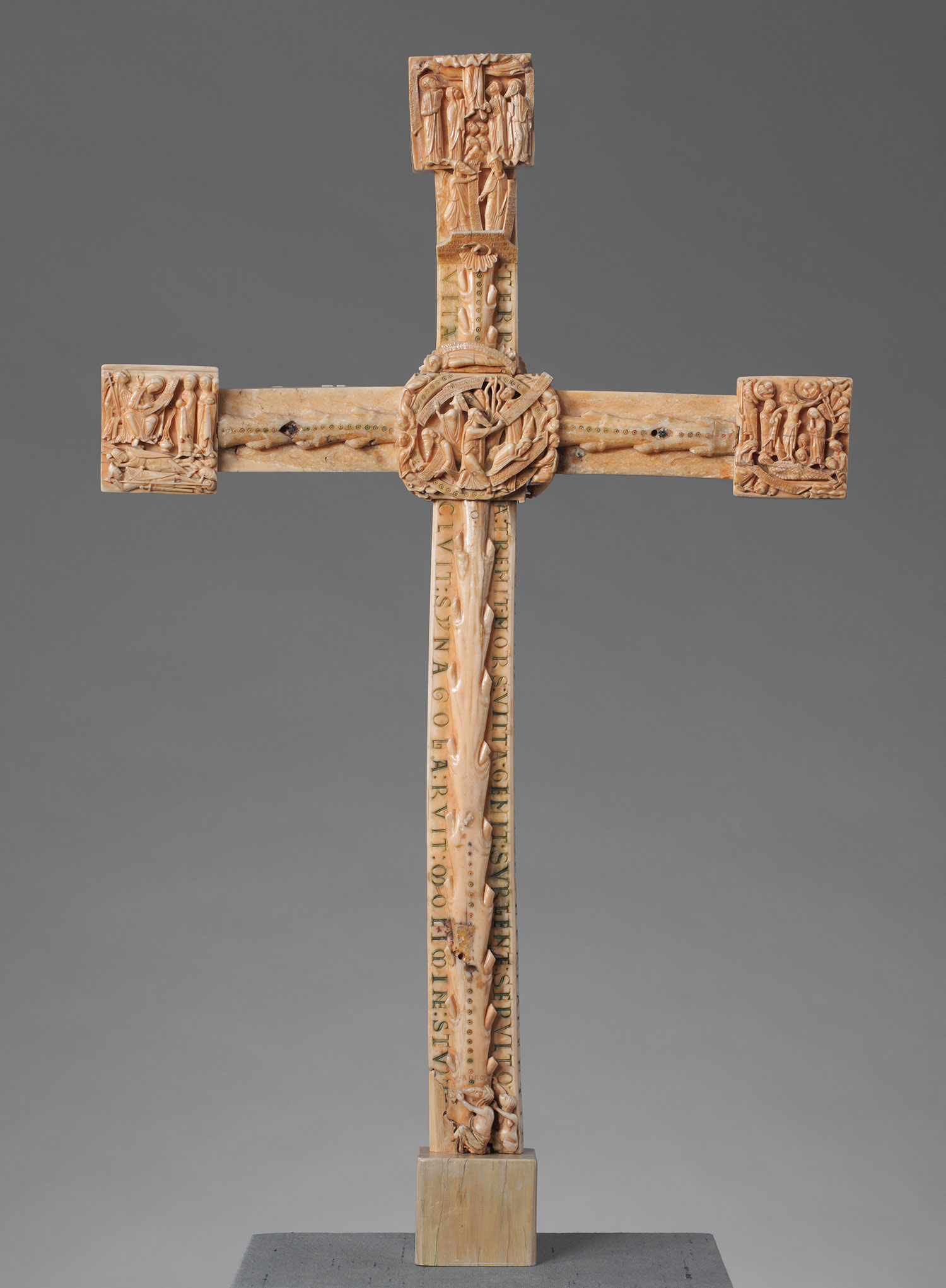
The Cloisters Cross (ft. my completely brilliant duplicate)
![]() |
| Actual Cross |
The Cloisters Cross, also know as the Bury St Edmonds Cross. The sculptor is unknown although there is speculation that it was carved by Master Hugo at the St Bury Edmonds Abbey in Suffolk of Eastern England. The walrus ivory cross measures 57.5 cm x 36.2 cm in size.
It is made of five pieces of walrus tusk ("Morse ivory") with about 92 figures and 98 engravings to illustrate a number of biblical scenes, and on the back a number of old testament prophets complete with quotations from its books. These carvings are inscribed with immense details to present several strong anti-Semitic feelings, hate against the Jews. Now, since we don't know for certain who the artist is, we don't exactly know with what aims this sculpture was carved. However, the cross certainly indicates some of the anti-Semitism prevalent in England during this time. Furthermore, if this gives any more indication, the Jews were expelled from the country by the end of the 13th Century.
Other context surrounding this pieces is when David I becomes king of the Scots in 1124. Among other influences, he patronized the church by building huge, beautiful new continental-style churches and cathedrals, much like those found in Glasgow, Elgin, and Saint Andrews. Then, in 1174, the Canterbury Cathedral is burned down, but gets rebuilt within 4 years. This time, its style created a hybridized English style by combining contemporary French and Anglo-Norman styles. This new style could have greatly influenced the sculpting of the Cloisters Cross.
![]() |
| Here's my drawing. Sorry about quality (perks of having a 2009 Dell laptop) |
Sunday, October 11, 2015
Sunday, September 13, 2015
The Handmaid's Tale
Author: Wing Young Huie
Photo Taken: 2007-2010
Place of Publication: http://photos.wingyounghuie.com/p929219206/h6cc35901#h6cc35901
At first glance, I can see a girl, who looks like a teenager, siting and holding a baby. The girl is dressed in jeans, a t-shirt and what looks like an oversized jacket. To the left of her are multiple bags, one of which is Nike, and to the right of her is a trash can. She is holding up a hand-written sign that says , "Never let your fears determine your decision."
Now, looking deeper into the picture, I imply that this girl is a teen mom because of the way she is holding the baby and her facial expression. She has a look of subtle determination on her face. Also, the baby looks like he or she is comfortable in the girl's arms, which further confirms my assumption that she is his or her mother. It also seems to me that the two are sitting in some type of center, maybe an abortion clinic or a planned parenthood center. My interpretation of the sign she is holding is that her fear was that having a baby at her age would ruin her life but she did not let that fear influence her to get an abortion or to give it up for adoption. I think the photographer's message here is that we should not assume that when a person of a young age has a baby that their life and all of their dreams are automatically over and we should not try to force them to believe that . Moreover, if the assumptions that I made about location of this picture are true, then the photographer may have also wanted to point out that conquering your fears is extremely important.
Both Atwood and the photographer use "othering" in contrasting ways. Atwood makes it clear that once the women in Gilead become handmaids, their former life and all of their happiness and freedom are taken away and they now belong to the Commanders they are assigned to. Contrastingly, the photographer uses this photo to say that on the surface, it appears that the girl's life is over because of the baby she has, however, the deeper message is that it is actually her decision whether to make her current situation define the rest of her life. Atwood poses the clear message that the handmaids do not get a say in how their life is defined going forward.
Subscribe to:
Comments (Atom)