2. "Power corrupts, and absolute power corrupts, absolutely."- Lord Acton
The rest of this quote reads, "Great men are almost always bad men." This quote arose in the 19th century in a very opinionated letter that Lord Acton wrote to Bishop Mandell Creighton to express his thoughts on the power given to absolute monarchs. The rest of the quote reads, "Great men are almost always bad men."
I take this quote mean that one who is given total authority is more than likely to abuse it, no matter how decent of a person they were prior to. Although I do see what Lord Acton was getting at when he said this, I do not necessarily agree with him. I believe that power and absolute power is more revealing than it is absolutely corruptive. In other words, all human beings have evil inside of us. We just need to placed under the right circumstances in order to bring them out. That is why, for example, babies know how to lie as soon as they know how to talk. This type of situation occurred when my younger brother was 3 years old. One day, he picked up my mom's glasses and broke them in half. My mom saw the entire thing, but when she asked him if he did it he said "no" and pointed at me to suggest that I broke them instead. Of course, he got in trouble for breaking the glasses but my mom was very baffled that at just 3 years old, he already knew how to lie. However, she later realized that it's because he was born with the capacity to do wrong already in his heart. It is the environment that a person is consistently around and the values that is instilled in oneself that determines whether the innate wrongdoing that one is born with will prevail in the future.
Another great example that can be taken into account is the Stanford Prison Experiment. This was a psychological study of the effects of becoming a prisoner versus a prison guard. College students at Stanford University volunteered to participate and were given the role of either a prisoner or a prison guard. Much to psychology professor Philip Zimbardo's surprise, the volunteers adapted to the roles very easily; so much so that the experiment had to be stopped early because it was getting out of hand. To make a long story short, those who played the prison guards enforced their authority to the highest degree, since they were given no limits. Ultimately, they subjected the prisoners to psychological torture, while the prisoners passively accepted the abuse and even, at the request of the guards, physically and verbally harassed other prisoners who were also powerless. In this situation, if Lord Acton's quote held true, this would also mean that those who are powerless become pure. However, this was not the case. Therefore, there is some flaw in Lord Acton's quote.
With regards to Macbeth, Shakespeare most likely would not agree with the quote, either. In the very beginning of the play, the three witches recite at the end of Act I, " Fair is foul, and foul is fair" (Shakespeare, 1.1). On the surface, one could say that they believe the things most men consider to be foul and ugly are just and beautiful to them because they embody evil. However, the deeper meaning of this quote could be that everything is not what it seems. It points to the discrepancy of appearance versus reality: the difference between how someone seems and how someone really is. With reference to the character of Macbeth, Shakespeare makes Macbeth seem like a decent person until the three witches prophecy to him that he will become Thane of Cawdor, and eventually King of Scotland. From that point on, Macbeth progressively turns into a malicious murderer because he thinks it is the inevitable thing to do to make the prophecy come true, especially since he most likely would not have been named Thane of Cawdor by King Duncan if the former one had not committed treason and consequently been killed. Shakespeare attempts to comment that Macbeth always had malice in his heart, but it was not exposed, to himself or to everyone else until he was put in a powerful position.
Conclusively, these examples prove that power is a source of exposure rather than a source of corruption. All people are innately evil but then are taught how to suppress their evil with good.
P.S. The remind text Mrs. Genesky sent with the "Ferris" joke was sent while I was in the middle of typing this. Coincidence or nah?
Sunday, November 22, 2015

Sunday, November 8, 2015
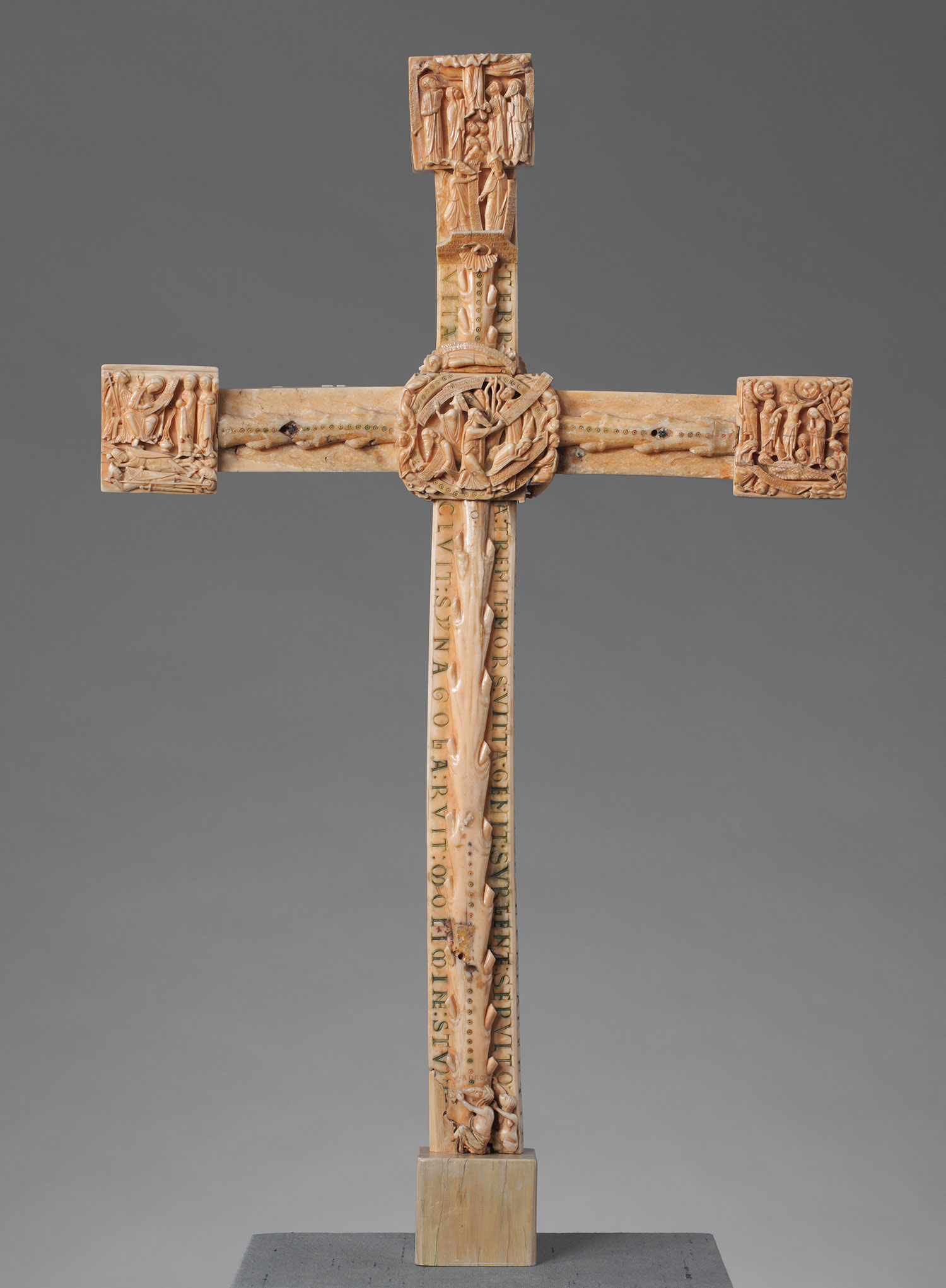
The Cloisters Cross (ft. my completely brilliant duplicate)

 |
| Actual Cross |
The Cloisters Cross, also know as the Bury St Edmonds Cross. The sculptor is unknown although there is speculation that it was carved by Master Hugo at the St Bury Edmonds Abbey in Suffolk of Eastern England. The walrus ivory cross measures 57.5 cm x 36.2 cm in size.
It is made of five pieces of walrus tusk ("Morse ivory") with about 92 figures and 98 engravings to illustrate a number of biblical scenes, and on the back a number of old testament prophets complete with quotations from its books. These carvings are inscribed with immense details to present several strong anti-Semitic feelings, hate against the Jews. Now, since we don't know for certain who the artist is, we don't exactly know with what aims this sculpture was carved. However, the cross certainly indicates some of the anti-Semitism prevalent in England during this time. Furthermore, if this gives any more indication, the Jews were expelled from the country by the end of the 13th Century.
Other context surrounding this pieces is when David I becomes king of the Scots in 1124. Among other influences, he patronized the church by building huge, beautiful new continental-style churches and cathedrals, much like those found in Glasgow, Elgin, and Saint Andrews. Then, in 1174, the Canterbury Cathedral is burned down, but gets rebuilt within 4 years. This time, its style created a hybridized English style by combining contemporary French and Anglo-Norman styles. This new style could have greatly influenced the sculpting of the Cloisters Cross.
 |
| Here's my drawing. Sorry about quality (perks of having a 2009 Dell laptop) |
Subscribe to:
Comments (Atom)